
Topic: 2. Sacrifice and religion: Comparisons, Antiquarians, Anthropology (16th-18th Century)
Religious sacrifices across various cultures and contexts sparked widespread interest in Early Modern Europe. As Christianity expanded into regions inhabited by "infidels" and "pagans", Europeans encountered a diverse array of sacrificial customs, ranging from the Sati rituals in India to the Aztec sacrifices in the Americas. This cross-cultural exposure captivated a wide audience, including theologians, philosophers, political thinkers, antiquarians, orientalists, missionaries, poets, artists, and even the general public. These encounters broadened the European understanding of sacrifice and led to a critical reassessment of classical and biblical sacrificial rites. This section includes:
- Sources: A selection of early modern printed materials, which include descriptions of the Americas, Asia, and Africa, alongside antiquarian and philological studies on religious sacrifice in classical antiquity and beyond. It also presents early modern works of ethnological observations and the first attempts to compare different sacrificial practices in various traditions and contexts, laying the groundwork for disciplines like the history of religions and anthropology.
- Iconographic Representations: A rich collection of images from the 16th to 18th centuries, illustrating a range of sacrificial rituals and practices as seen in different cultural and geographical contexts.
- Related Bibliography: An extensive bibliography spanning scholarly works from the 19th to 21st centuries, providing contemporary analyses and interpretations of these early studies and observations.
Un texte grec relatif à l’Ashvamedha
in: Extract de “Journal Asiatique”, v. (1930), issue : pp..
Des Herrn Racine Trauerspiel Iphigenia, vor einigen Jahren ins deutsche übersetzt, Nunmehro aber mit einer Vorrede und einem Auszuge aus der griechischen Ipigenia des Euripides ans Licht gestellet
Leipzig: Bernhard Christoph Breitopf, 1734.
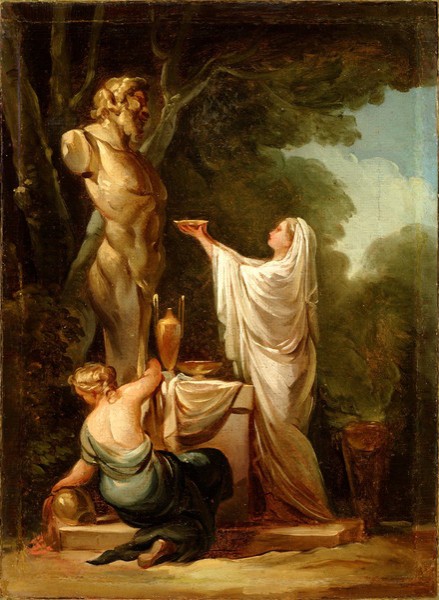
Sacrifice to Pan (1771)
Colección particular, Zaragoza (Spain)
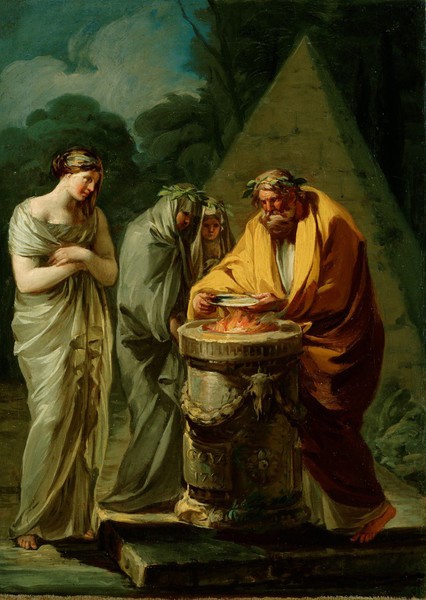
Sacrifice to Vesta (1771)
Colección Félix Palacios Remondo, Zaragoza (Spain)
The Scapegoat Tradition: A Study in Early Jewish Interpretation
in: Journal for the Study of Judaism in the Persian, Hellenistic, and Roman Period, v. 18 (1987), issue 2: pp.152-167.
Jagdbeute und Schlachttier in islamischen Recht
Bonn: Selbstverlag des Orientalischen Seminars, 1959.
A Satirist's Sacrifices : Lucian's On Sacrifices and the Contestation of Religious Traditions
in: Ancient mediterranean sacrifice, pp. 203-213
Oxford: Oxford University Press, 2011.
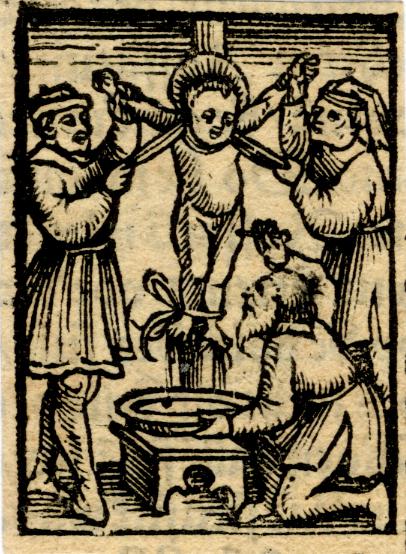
The martyrdom of Simon of Trent; a small child tied to a pole with two men cutting his skin while another holds a bowl underneath the boy's feet to collect the blood; illustration to Jacobus de Voragine, 'Passionael efte dat levent der hyllighten', Basel: Adam Petri, 1517. (1517)
from: Jacobus de Voragine, Passionael efte dat levent der hyllighten', Basel, Adam Petri, 1517
British Museum
Letters on India
London-Edinburgh: Longman-Constable, 1814.
Les Anciennes Liturgies, ou, La Maniere Dont On A Dit la sainte Messe dans chaque siècle : dans les Eglises d'Orient & dans celles d'Occident : Avec la recherche de toutes les Pratiques, Prières & Ceremonies qui s'observent dans le saint Sacrifice
Paris: Jean de Nully, 1697.
Note sur le sacrifice chez les Arabes musulmans
in: Le sacrifice II, Systèmes de pensée en Afrique noire, pp. 87-114
: , 1978.
Aztec Human Sacrifice as Expiation
in: History of Religions, v. 39 (2000), issue 4: pp.352-271.
Racine: From Ancient Myth to Tragic Modernity
Minneapolis - London: University of Minnesota Press, 2010.
Otros, ciegos en la ignorancia, habían hecho muchas idolatrías y sacrificios de animales al modo antiguo, por persuasión de los hechiceros, y se volvían a la fuente de agua viva, tomando venganza de su atrevimiento con las disciplinas, y entre estos hombres hubo quien sacrificó nueve animales, chicos y grandes, y con este miserable rito vivía descuidadamente en otros muchos pecados, encubriéndolos y faltando a la fidelidad de su Dios muchos años.
in: “Monumenta Peruana (Letter from Gregorio Cisneros to Manuel Vazquez), Rome, 1974, vol. 6”
: , 1597.
Un religiosso con celo de la gloria de Dios, viendo el daño questa vestia hazía, juntando mucha gente y algunos españoles, fue a esta guaca, y entrando en ella con una acha, sobrepelliz y estola y agua vendita, pidiendo al Señor el divino fabor, porque tenía grandes contradiciones de los indios, alló en ella un cerricto echo de la propia peña, detrás del qual dava el demonio sus respuestas, y en una concavidad de la peña estava una figura a manera de carnero, labrada de plata, y en toda la qüeba gran cantidad de lanas de diferentes colores, güesos de animales con otras mill savandijas, que avían ofrescido.
in: “Monumenta Peruana (Letter from Gregorio Cisneros to Claudio Acquaviva), Rome, 1974, vol. 6”
: , 1599.
Remarques sur le mecanisme du sacrifice dogon
in: Journal de la Societe des Africanistes, v. 10 (1940), issue : pp.176-208.
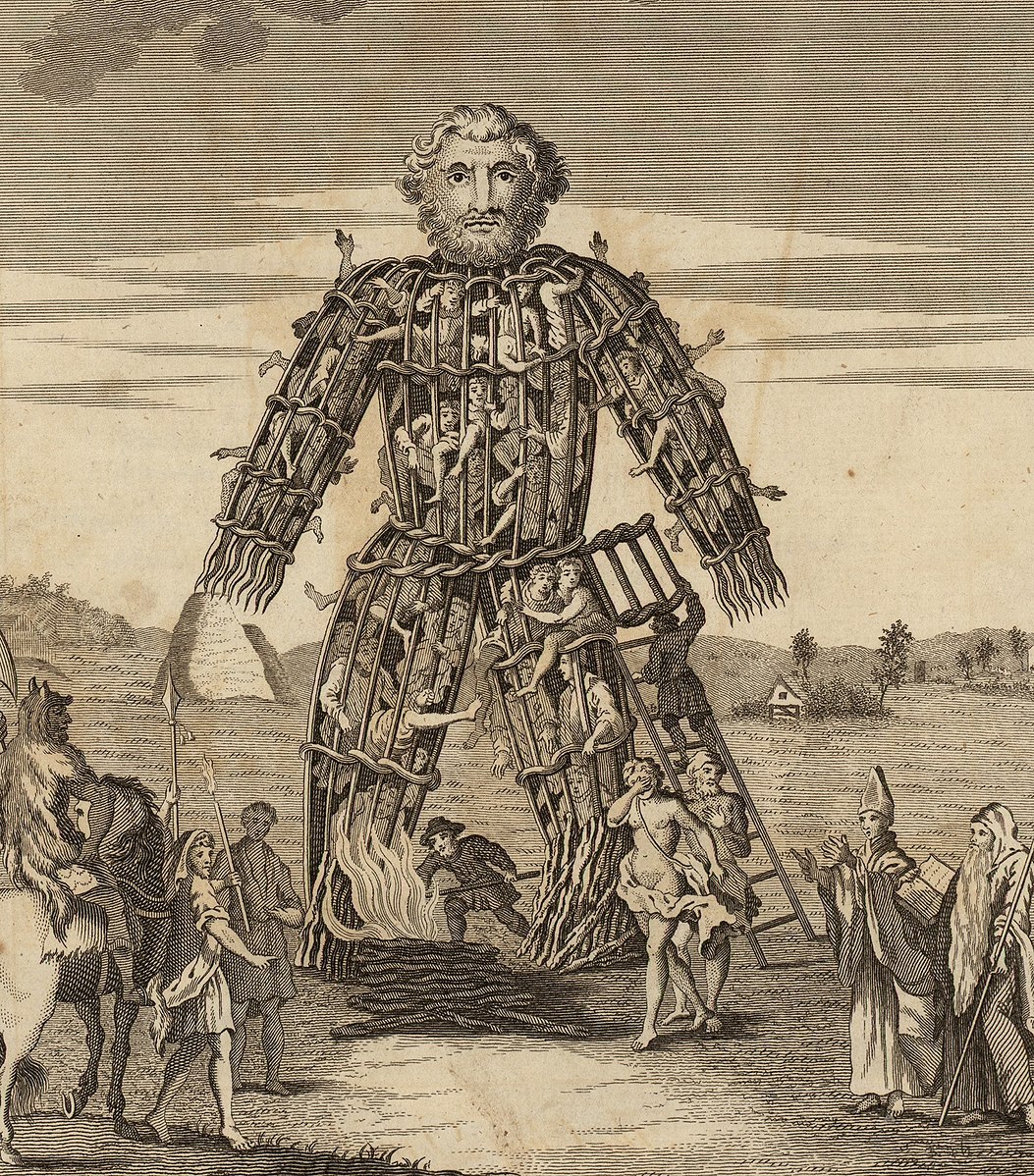
The Wicker Man of the Druids Crop (18th Century)
from: Pennant, Thomas. A Tour in Wales, London, H.D. Symonds, 1781