
Topic: 2. Sacrifice and religion: Comparisons, Antiquarians, Anthropology (16th-18th Century)
Religious sacrifices across various cultures and contexts sparked widespread interest in Early Modern Europe. As Christianity expanded into regions inhabited by "infidels" and "pagans", Europeans encountered a diverse array of sacrificial customs, ranging from the Sati rituals in India to the Aztec sacrifices in the Americas. This cross-cultural exposure captivated a wide audience, including theologians, philosophers, political thinkers, antiquarians, orientalists, missionaries, poets, artists, and even the general public. These encounters broadened the European understanding of sacrifice and led to a critical reassessment of classical and biblical sacrificial rites. This section includes:
- Sources: A selection of early modern printed materials, which include descriptions of the Americas, Asia, and Africa, alongside antiquarian and philological studies on religious sacrifice in classical antiquity and beyond. It also presents early modern works of ethnological observations and the first attempts to compare different sacrificial practices in various traditions and contexts, laying the groundwork for disciplines like the history of religions and anthropology.
- Iconographic Representations: A rich collection of images from the 16th to 18th centuries, illustrating a range of sacrificial rituals and practices as seen in different cultural and geographical contexts.
- Related Bibliography: An extensive bibliography spanning scholarly works from the 19th to 21st centuries, providing contemporary analyses and interpretations of these early studies and observations.
Muslim ritual models in two pre-colonial Moroccan Berber societies: covenant, conditional curse, shame compulsion and sacrifice
in: Journal of North African Studies, v. 6 (2004), issue 2: pp.61-80.
Sacrifice-Sudra
in: Encyclopaedia of Religion and Ethics
Edinburgh - New York: T.T. Clark - C. Scribner's Sons, 1981.
The slaughter of a ḍaḥiyya during ḥajj and the origins of ʿīd al-aḍḥā
in: Jerusalem Studies in Arabic and Islam , v. 31 (2006), issue : pp.58-73.
The Talking Greeks. Speech, Animals, and the Other in Homer, Aeschylus, and Plato
Cambridge: Cambridge University Press, 2005.
God’s gift of prayer to the children of Abraham: Christians and Muslims in sacrificial solidarity
in: Islamochristiana / Dirāsāt Islāmīyah Masīḥīyah, v. 41 (2015), issue : pp.57-73.

The Broken World of Sacrifice: An Essay in Ancient Indian Ritual
Chicago: University of Chicago Press, 1993.
Non-violence and sacrifice
in: Indologica Taurinensia, v. 12 (1984), issue : pp.223-244.
Self-sacrifice in Vedic Ritual
in: Gilgul: Essays on Transformation, Revolution, and Permanence in the history of religion, pp.
Leiden: Brill, 1987.
Three Crucial Aspects of Religion in Human Evolution: Shamanism, Sacrifice and Exogamic Alliance
in: European Journal of Sociology / Archives Européennes de Sociologie / Europäisches Archiv Für Soziologie, v. 53 (2012), issue 3: pp.327–335.
Le sacrifice chez les Arabes
in: Ethnos (Folkens Museum Etnografiska Stockholm), v. 13 (1948), issue : pp.1-16.
Über Menschenopfer bei den vorislamischen Arabern
in: Akten des Vierundzwanzigsten internationalen Orientalisten-Kongresses, pp. 244-246
Wiesbaden: Deutsche Morgenländische Gesellschaft, 1959.
Drama and Dromena: Bloodshed, Violence, and Sacrificial Metaphor in Euripide
in: Harvard Studies in Classical Philology, v. 100 (2000), issue : pp.173–188.
Feasts of paradise: banqueting and sacrifice in the Islamic tradition
in: Holy wealth: accounting for this world and the next in religious belief and practice. Festschrift for John R. Hinnells, pp. 131-144
Wiesbaden: Harrassowitz Verlag, 2017.
Sacrifice symbolique ou sacrifice efficace
in: a Fonction symbolique. Essai d’anthropologie
Paris: Gallimard, 1979.
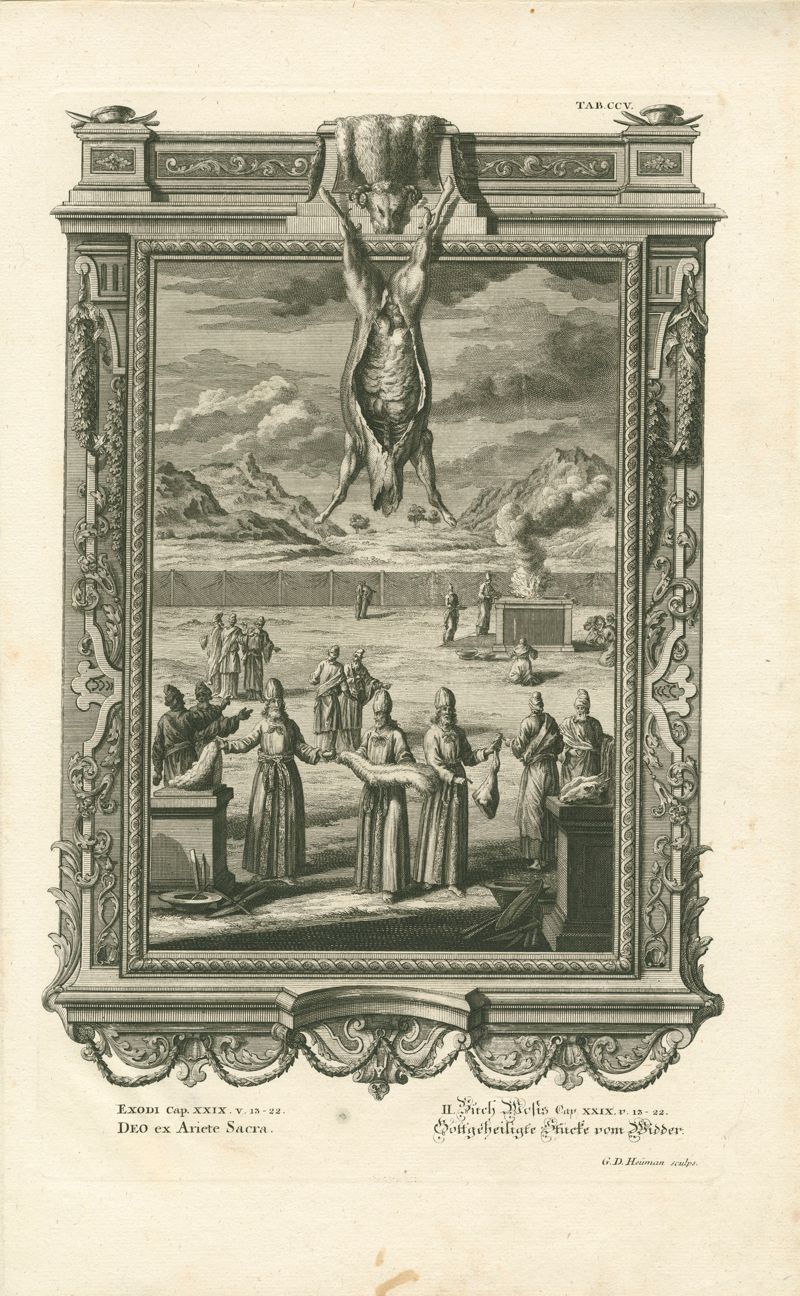
Aaron and his sons sacrificing a ram, as described in Exodus 29:13-22 (1731)
from: Scheuchzer, Johann Jakob, Physica Sacra (Kupfer-Bibel), Augsburg and Ulm, Christian Ulrich Wagner, 1731-1735, vol. 2, p. 324
Lowcountry Digital Library
Le sacrifice dans les religions africaines
Paris: Gallimard, 1986.

Discovery of the leaden books of Sacromonte (Granada) [1741]
from: Heredia Barnuevo, Diego N. Mystico ramillete historico, chronologyco, panegyrico, texido de las tres fragrantes flores del nobilissimo antiguo origen, exemplarissima vida, y meritissima fama posthuma del Ambrosio de Granada ... el Illmo. y V.Sr. Don Pedro de Castro, Vaca y Quiñones ... Arzobispo de Granada, y Sevilla, y Fundador Magnifico de la Insigne Iglesia Colegial del Sacro Monte Illipulitano, Granada, Imprenta Real, 1741.
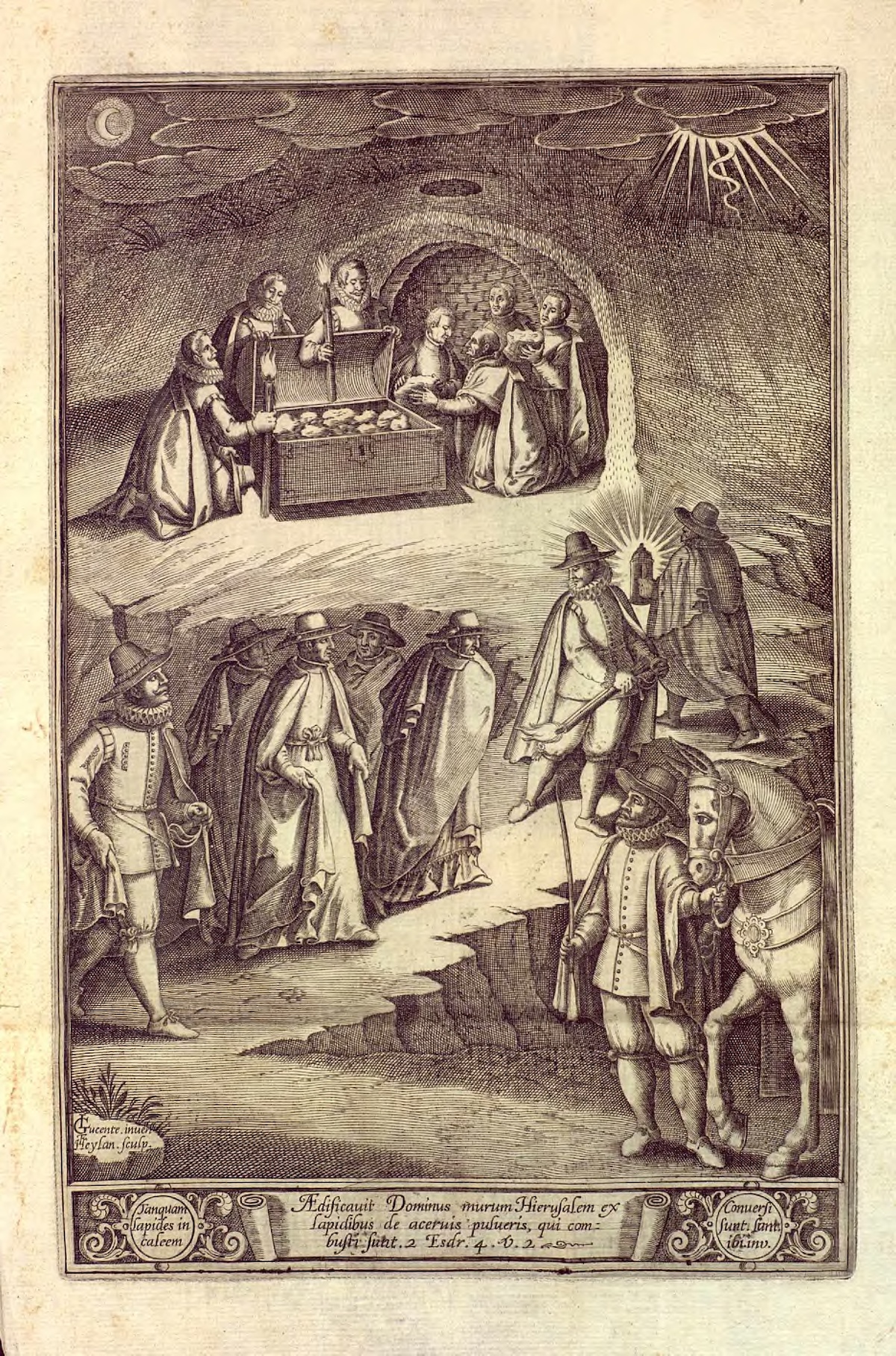
Discovery of the leaden books of Sacromonte (Granada) [1741]
from: Heredia Barnuevo, Diego N. Mystico ramillete historico, chronologyco, panegyrico, texido de las tres fragrantes flores del nobilissimo antiguo origen, exemplarissima vida, y meritissima fama posthuma del Ambrosio de Granada ... el Illmo. y V.Sr. Don Pedro de Castro, Vaca y Quiñones ... Arzobispo de Granada, y Sevilla, y Fundador Magnifico de la Insigne Iglesia Colegial del Sacro Monte Illipulitano, Granada, Imprenta Real, 1741.