
Topic: 2. Sacrifice and religion: Comparisons, Antiquarians, Anthropology (16th-18th Century)
Religious sacrifices across various cultures and contexts sparked widespread interest in Early Modern Europe. As Christianity expanded into regions inhabited by "infidels" and "pagans", Europeans encountered a diverse array of sacrificial customs, ranging from the Sati rituals in India to the Aztec sacrifices in the Americas. This cross-cultural exposure captivated a wide audience, including theologians, philosophers, political thinkers, antiquarians, orientalists, missionaries, poets, artists, and even the general public. These encounters broadened the European understanding of sacrifice and led to a critical reassessment of classical and biblical sacrificial rites. This section includes:
- Sources: A selection of early modern printed materials, which include descriptions of the Americas, Asia, and Africa, alongside antiquarian and philological studies on religious sacrifice in classical antiquity and beyond. It also presents early modern works of ethnological observations and the first attempts to compare different sacrificial practices in various traditions and contexts, laying the groundwork for disciplines like the history of religions and anthropology.
- Iconographic Representations: A rich collection of images from the 16th to 18th centuries, illustrating a range of sacrificial rituals and practices as seen in different cultural and geographical contexts.
- Related Bibliography: An extensive bibliography spanning scholarly works from the 19th to 21st centuries, providing contemporary analyses and interpretations of these early studies and observations.
Langar : pèlerinage, échanges sacrés et sacrifice permanent autour d’un saint soufi au Pakistan
in: Sacrifices en Islam: Espaces et temps d'un rituel, pp. 287-306
: , 1999.
Sacrificing Judith
in: Sacrifice in Modernity : Community, Ritual, Identity : from Nationalism and Nonviolence to Health Care and Harry Potter, pp. 201-217
Leiden: Brill, 2017.
Animal Sacrifice and the Origins of Islam
Cambridge: Cambridge University Press, 2022.
Gift of the body in Islam: the Prophet Muhammad’s camel sacrifice and distribution of hair and nails at his farewell pilgrimage
in: Numen, v. 57 (2010), issue 3-4: pp.341-388.
The Ethnographic Lens In The New World: Staden, De Bry, And The Representation Of The Tupi In Brazil
in: Early Modern Eyes Series, pp. 81-104
Leiden: Brill, 2010.
Die Religionen Irans
Stuttgart: W. Kohlhammer Verlag, 1965.
Asante: human sacrifice or capital punishment? A rejoinder.
in: The International Journal of African Historical Studies, v. 21 (1988), issue 3: pp.443-452.
Crime, Cult and Capital Punishment (Mo'alla Inscription 8)
in: Journal of Egyptian Archaeology, v. 76 (1990), issue : pp.27-54.
God on trial. Human sacrifice, trickery, and faith
in: Journal of Ethnographic Theory, v. 3 (2013), issue 1: pp.140–154.
Sacrifice As the Ideal Hunt: A Cosmological Explanation for the Origin of Reindeer Domestication
in: Journal of the Royal Anthropological Institute, v. 21 (2015), issue 1: pp.1-23.
Aegyptiaca, et dekaphylon, sive de Aegyptiacorum sacrorum cum Hebraicis collatione libri tres (I, chap. 7)
Amsterdam: Borstius, 1696.
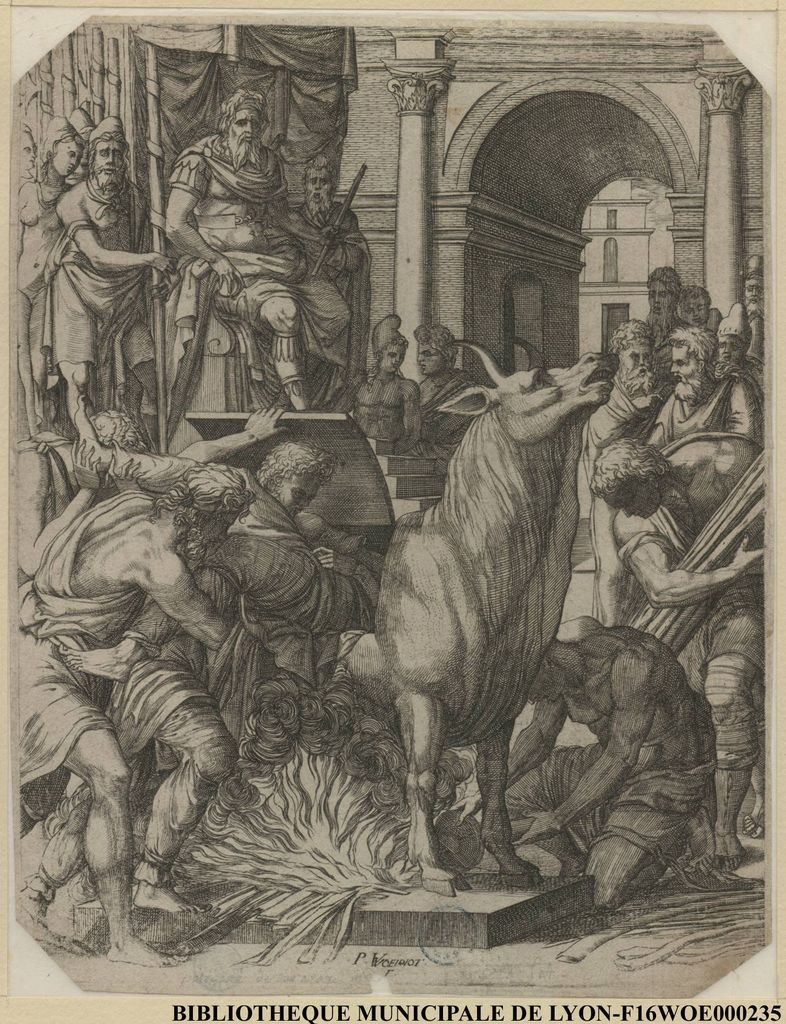
The Phalaris bull (16th Century)
Bibliothèque municipale, Lyon

Martyrium des Simon von Trent, Darstellung aus der Nürnberger Weltchronik von Hartmann Schedel - Purported Martyrdom of Simon of Trent, depiction from the Nuremberg World Chronicle by Hartmann Schedel. (1493)
from: Hartmann Schedel, Nürnberger Weltchronik

Cain and Abel Sacrifices (1493)
from: Schedel, Hartmann. Liber chronicarum, Nuremberg, 1493, c. 9v
Bayerische Staatsbibliothek, Rar. 287, Münich
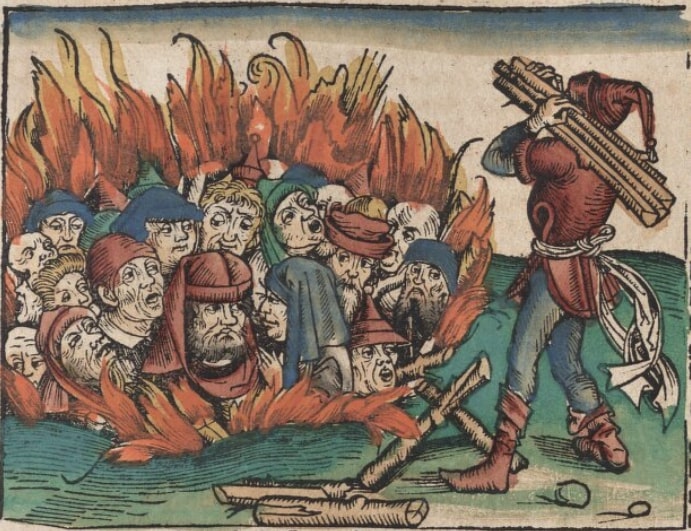
Heretic Jewish at the Stake (1493)
from: Schedel, Hartmann. Liber chronicarum, Nuremberg, 1493, c. 230v
Bayerische Staatsbibliothek, Rar. 287, Münich
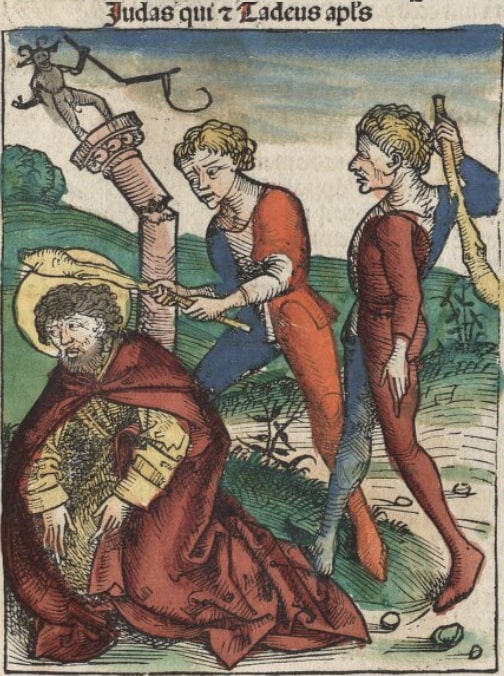
Martyrdom of Judas Thaddeus (1493)
from: Schedel, Hartmann. Liber chronicarum, Nuremberg, 1493, c. 107v
Bayerische Staatsbibliothek, Rar. 287, Münich