
Death and Demonization of a Bodhisattva: Guanyin's Reformulation within Chinese Religion
in: Journal of the American Academy of Religion, v. 84 (2016), issue 3: pp.690-726.
External link:
www.jstor.org
Edited by: Chiara Petrolini
Related Documents:
An Eighteenth-Century Account of Sati: John Zephaniah Holwell's ‘Religious Tenets of the Gentoos’ and ‘Voluntary Sacrifice’ (1767)
in: South Asia: Journal of South Asian Studies, v. 40 (2017), issue 1: pp.24-39.
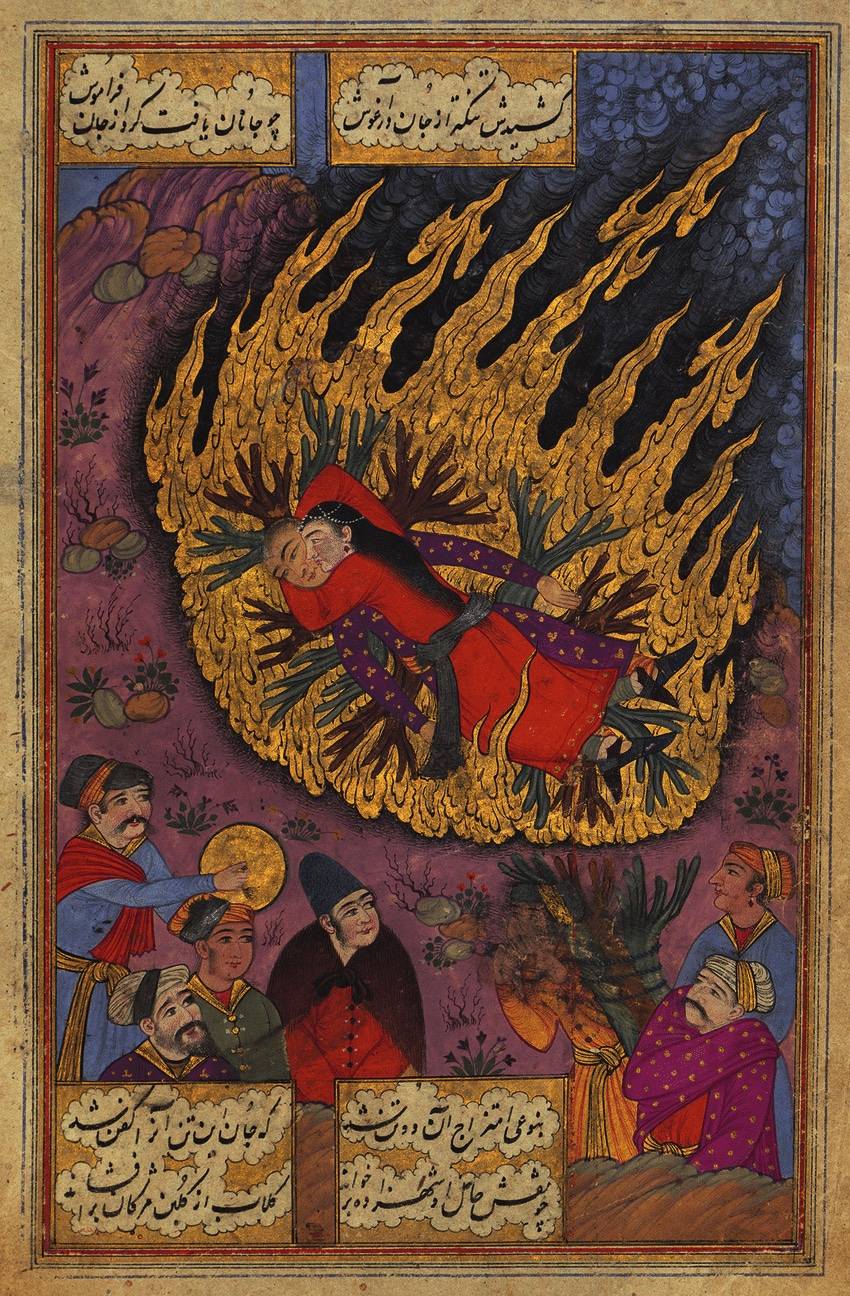
Satī, from a Sūz u Gudāz manuscript. The union of the couple on the pyre (1657)
from: Sūz u Gudāz ms, Iran, Walters Manuscript W. 649, fol. 19b (Burning and Melting)
The Walters Art Museum, Baltimore, Maryland
Multiple Meanings of Buddhist Self-Immolation in China: A Historical Perspective
in: Revue d'Etudes Tibétaines, v. 25 (2012), issue : pp.203-212.
The Legend of Miaoshan
London: Ithaca Press, 1978.
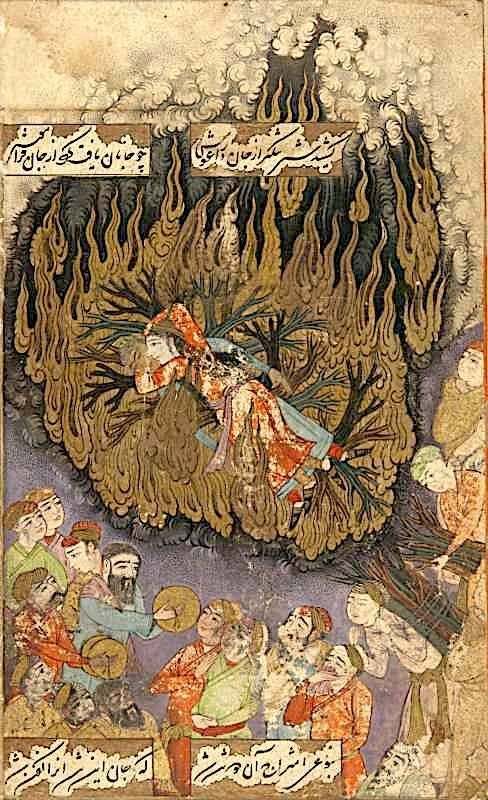
Satī. The bride immolates herself on the funeral pyre (1657)
from: Isfahan, Iran
The Israel Museum, Jerusalem