
Topic: 2. Sacrifice and religion: Comparisons, Antiquarians, Anthropology (16th-18th Century)
Religious sacrifices across various cultures and contexts sparked widespread interest in Early Modern Europe. As Christianity expanded into regions inhabited by "infidels" and "pagans", Europeans encountered a diverse array of sacrificial customs, ranging from the Sati rituals in India to the Aztec sacrifices in the Americas. This cross-cultural exposure captivated a wide audience, including theologians, philosophers, political thinkers, antiquarians, orientalists, missionaries, poets, artists, and even the general public. These encounters broadened the European understanding of sacrifice and led to a critical reassessment of classical and biblical sacrificial rites. This section includes:
- Sources: A selection of early modern printed materials, which include descriptions of the Americas, Asia, and Africa, alongside antiquarian and philological studies on religious sacrifice in classical antiquity and beyond. It also presents early modern works of ethnological observations and the first attempts to compare different sacrificial practices in various traditions and contexts, laying the groundwork for disciplines like the history of religions and anthropology.
- Iconographic Representations: A rich collection of images from the 16th to 18th centuries, illustrating a range of sacrificial rituals and practices as seen in different cultural and geographical contexts.
- Related Bibliography: An extensive bibliography spanning scholarly works from the 19th to 21st centuries, providing contemporary analyses and interpretations of these early studies and observations.
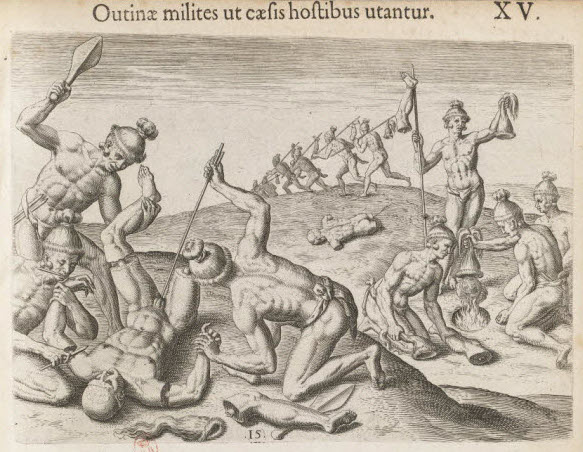
Soldiers of Outina Holata skinning and scalping their enemies. Sacrifices of the enemies (1591)
from: Le Moyne de Morgues, J. Brevis narratio eorum quae in Florida Americae provincia Gallis acciderunt, secunda in illam navigatione duce Renato de Landonniere Classis praefecto, Frankfurt, Theodor de Bry, 1591, p. 14
Bibliothèque Nationale de France, Paris
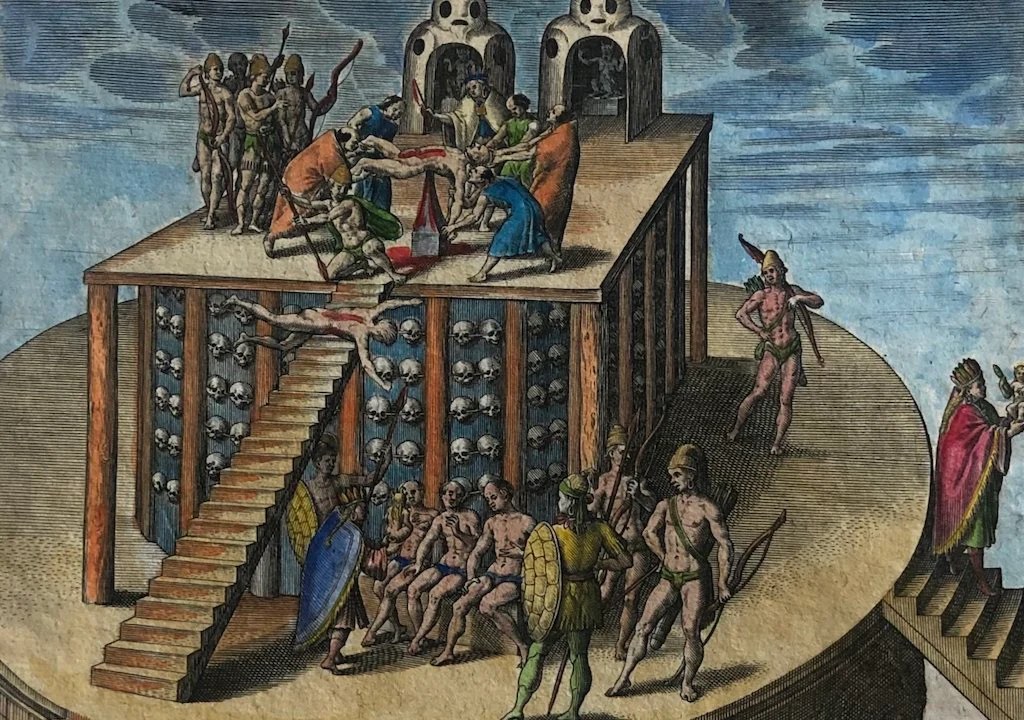
Tenochtitlan, human sacrifice on Templo Mayor.VIII. Qua ratione Indi Mexicani, mactatis hominibus sacrificent (1602)
from: Jansz, Bernhardus - Bry, Theodor de. [Collectio peregrinationum in Indiam occidentalem] : 9 : Americæ Nona & postrema Pars. Qua de Ratione Elementorum: De Novi Orbis Natura: De Huius Incolarum Superstitiosis cultibus, Frankfurt, Bekerum, 1602, VIII. Qua ratione Indi Mexicani, mactatis hominibus sacrificent
Österreichische Nationalbibliothek, Vienna
Sacrifice in the post-Kantian Tradition : Perspectivism, Intersubjectivity, and Recognition
Albany: State University of New York Press, 2014.
Civil war and religion in medieval Japan and medieval Europe: War for the Gods, emotions at death and treason
in: The Indian Economic & Social History Review, v. 57 (2020), issue 2: pp.261-287.
Dalla guerra alle meraviglie orientali: le letture della Flor des estoires de la terre d’Orient nel Medioevo Irene Bueno
in: Mélanges de l’École française de Rome - Moyen Âge, v. 130 (2018), issue 1: pp.53-71.
L’Oriente in città: crociate, manoscritti e nuovi saperi ad Avignone
in: A banchetto con gli amici: studi per Massimo Montanari, pp. 219-230
Roma: Viella, 2021.
2. Sacrifice and religion: Comparisons, Antiquarians, Anthropology (16th-18th Century) 5. Sacrifices of self: Martyrology and crusades including Reconquista (12th-20th Century)
Homo necans: interpretationen altgriechischer Opferriten und Mythen
Berlin-New York: De Gruyter, 1972.
Camel
in: Encyclopaedia Iranica, v. - (1990), issue -: pp.open access.
Idolatry, Markets, and Confession: The Global Project of the de Bry Family
in: Protestant Empires: Globalizing the Reformations, pp. 140-176
Cambridge: Cambridge University Press, 2020.
Understanding Aztec Cannibalism
in: Archiv Für Religionspsychologie / Archive for the Psychology of Religion, v. 26 (2004), issue : pp.1-14.
Creation of the Sacred: Tracks of Biology in Early Religion
Cambridge: Cambridge University Press, 1996.
The problem of Ritual Killing
in: Violent Origins: Walter Burkert, René Girard, and Jonathan Z. Smith on Ritual Killing and Cultural Formation, pp. 149-176
Stanford: Stanford University Press, 1987.
Sacrificio-Sacrilegio: il trickster fondatore
in: Sacrificio e società nel mondo antico, pp. 163-175
Roma - Bari: Laterza , 1988.
Sacrificial Violence: A Problem in Ancient Religions
in: The Oxford Handbook of Religion and Violence, pp. 437–454
Oxford: Oxford University Press, 2013.
0. General bibliography (19th-21th Century) 2. Sacrifice and religion: Comparisons, Antiquarians, Anthropology (16th-18th Century) 3. Sacrifice and politics (16th-18th Century)
The Anatomy of Melancholy What It Is. With All the Kindes, Causes, Symptomes, Prognostickes, and Severall Cures of It. In Three Maine Partitions With Their Severall Sections, Members, and Subsections. Philosophically, Medicinally, Historically, Opened and Cut Up. By Democritus Iunior. With a Satyricall Preface, Conducing to the Following Discourse
Oxford: John Lichfield - James Short, 1621.
Synagoga judaica, hoc est schola judaeorum, in qua nativitas, institutio, religio, vita, mors sepulturaque ipsorum, e libris eorundem, a M. Johanne Buxdorfio, descripta est. addita est mox per eundem judaei cum christiano disputatio de messia nostro. quae utraque germanica nunc latine reddita sunt, opera
Hanau: Hæredum Guilielmi Antoni, 1614.
Le radici cristiane dell'antisemitismo politico (fine XIX-XX secolo)
in: Alle origini dell'antisemitismo politico: l'accusa di omicidio rituale nel Sei-Settecento tra autodifesa degli ebrei e pronunciamenti papali, pp. 25-59
Roma: Ecole Française de Rome, 2003.