Goat and she-goat, turned to right, adorned for sacrifice
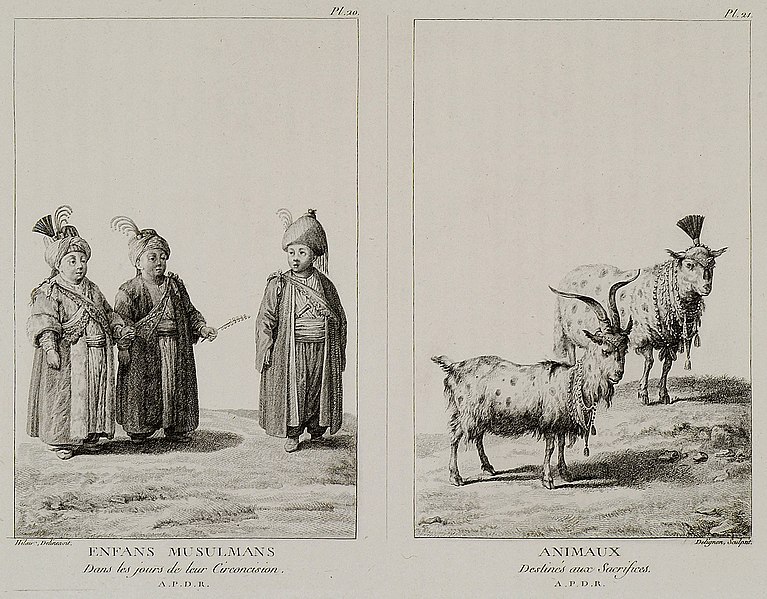
Year: 1626-1704
From: Ohsson, Ignace Mouradja d', Tableau général de l'Empire othoman, Paris, Didot, 1787-1820, vol. 2
Location: Wikimedia
Authority file: https://viaf.org/viaf/107032437/
Edited by: Chiara Petrolini
Related Documents:

A mountain city with multistoried hill architecture. Outside the gates on the right is a Saivite shrine with a lingum covered by floral offerings to which a goat is led, probably for sacrifice. (17th)
from: Unidentified Hindu chronicle of a King
Metropolitan Museum, New York
Emulating Abraham: the Fāṭimid al-Qā’im and the Umayyad ʿAbd al-Raḥmān III
in: Public violence in Islamic societies: power, discipline, and the construction of the public sphere, 7th-19th centuries CE, pp. 130-155
Edinburgh: Edinburgh University Press, 2009.
Keywords: Islam
Tableau général de l'Empire othoman. 3 vols: vol. 2
Paris: Firmin Didot, 1787-1820.
Quand le rite devient technique. Sacrifice et abattage dans le monde musulman
in: Techniques & Culture, v. 21 (1993), issue : pp.79-96.
A Gagauz folk adaption of the Karamanlidika poem Abraham’s sacrifice: a comparative linguistic approach
in: Cultural encounters in the Turkish-speaking communities of the late Ottoman Empir, pp. 257-277
Istanbul: Isis, 2014.
Keywords: IslamOttoman Empire